
An open door. A step still extended. A shore-power cable still connected.
Before an ambulance moves, the crew needs to know.
During an intervention, they also need the right controls within reach: warning lights in the cab, temperature settings at the treatment position, loading lights at the rear doors.
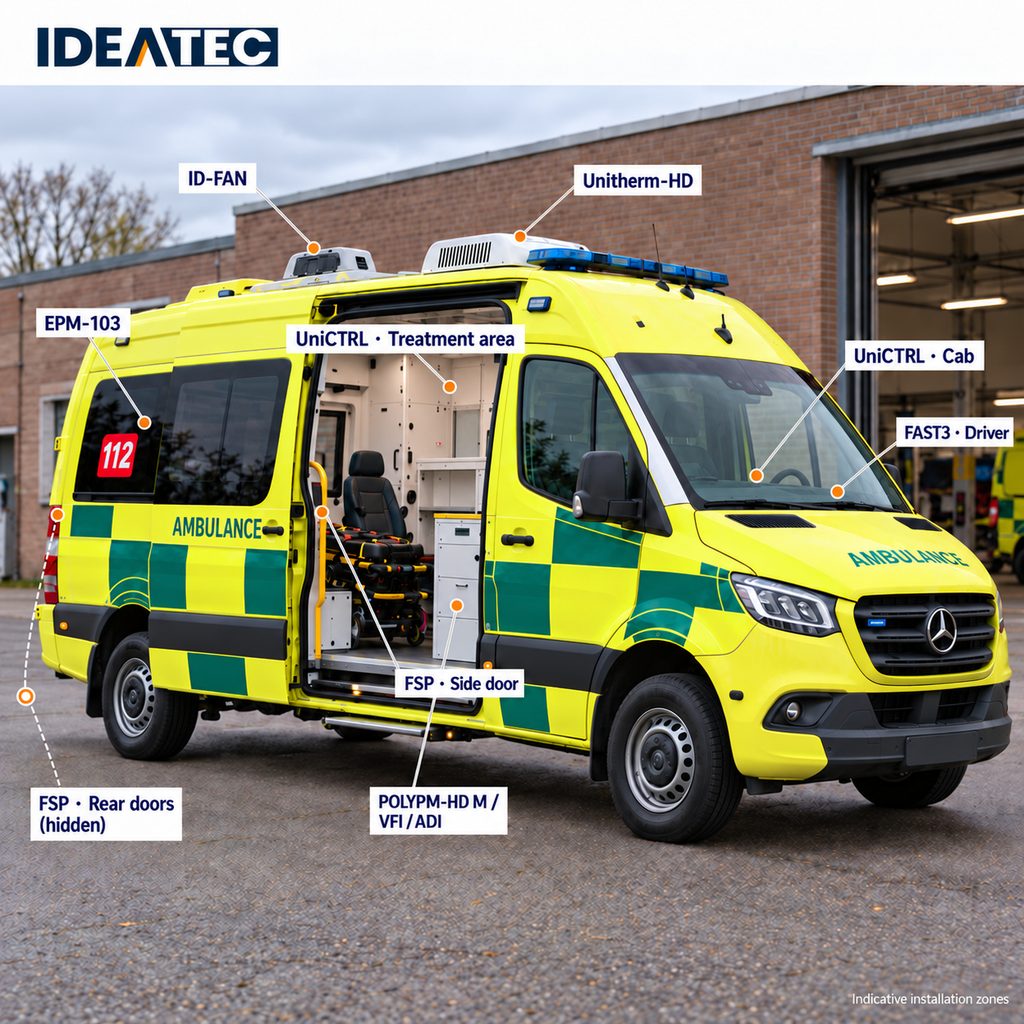
Here is how nine IDEATEC products can support a fully equipped Type C ambulance:
▪ POLYPM-HD M | Central control, integrated siren.
Controls warning lights and auxiliary equipment while removing the need for a separate siren module.
▪ EPM-103 | Power where it is needed.
Adds outputs at the rear for equipment such as loading lights or a medication refrigerator. Shorter power cable runs, less wiring back to the central cabinet.
▪ Unitherm-HD | Temperature control from the care position.
Brings compatible heating and air-conditioning systems onto the vehicle’s control interfaces.
▪ ID-FAN | Airflow under control.
Lets the crew operate ventilation and extraction from the same consoles as the other vehicle functions.
▪ 2 × UniCTRL | An overview in both compartments.
One touchscreen in the cab, one in the treatment area: vehicle status for the driver and direct access to patient-compartment settings for the clinician.
▪ 2 × FSP | Physical buttons at the point of use.
Keypads at the side door and rear doors give the crew direct access to essential functions, including when wearing gloves.
▪ FAST-3 | Emergency functions within the driver’s reach.
Provides direct access to emergency functions, helping the driver keep their attention on the road.
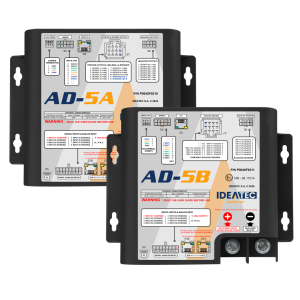
▪ VFI | Alerts the crew can hear.
Voice messages can flag an open door, an extended step or a connected shore-power cable, with separate audio channels for the cab and patient compartment.
▪ ADI | Measurements that inform decisions.
Reads compatible sensors to monitor values such as oxygen pressure and battery voltage, supporting displays and alerts.
For the vehicle converter, these choices shape the wiring and integration. For the crew, they determine how easily the ambulance can be operated throughout an intervention.
Where does your crew need the next control?
Illustrative configuration. Compatibility and integration must be confirmed for each project